#16DiasDeAtivismo - Direitos humanos e política migratória: uma lacuna cada vez maior
Por María Monserrat Escudero e Dolores Modern
Os direitos humanos em contexto
Este ano, comemorar o Dia dos Direitos Humanos é fundamental.
O marco dos direitos humanos tem guiado governos, políticos e sociedades em geral durante décadas, consagrando o valor da vida humana, a dignidade e a compaixão além das fronteiras. É alarmante que esse consenso esteja agora sendo questionado em nível mundial. No Reino Unido, isso fica claro no compromisso de alguns membros do Parlamento de revogar a Lei dos Direitos Humanos e abandonar a Convenção Europeia dos Direitos Humanos. Mas não é necessário ir tão longe para colocar em risco nossos direitos humanos. Ao demonizar a imigração, este governo está alimentando o discurso que questiona se todos merecemos os mesmos direitos.
Os direitos humanos estão interligados e, mais importante ainda, são inerentes a todos os seres humanos. Ao privar certos grupos de pessoas de seus direitos fundamentais, estamos privando-os de sua humanidade. No contexto dos 16 dias de ativismo, em que o foco está na importância de erradicar a violência contra mulheres e meninas, a interligação dos direitos humanos ganha destaque.
O efeito desumanizador do ambiente hostil à imigração
Não se pode subestimar a crueldade do ambiente hostil em que vivemos atualmente, nós, Imigrantes , requerentes de asilo e refugiados. Nossas comunidades têm visto sua vulnerabilidade aumentar progressivamente ao longo dos anos. E quando pensávamos que as coisas não poderiam piorar mais, um governo no qual muitos de nós depositávamos nossas esperanças se voltou contra nós.
Os imigrantes se tornaram bodes expiatórios de todos os tipos de falhas do Estado. Somos culpados pela crise imobiliária, pela austeridade que afeta a classe trabalhadora, pela queda dos salários e pela piora das condições de trabalho. Não há provas que demonstrem que a imigração tenha causado qualquer um desses problemas, nem que reduzi-la poderia resolvê-los. No entanto, a ideia de que os imigrantes, requerentes de asilo e refugiados estão empobrecendo o Reino Unido ao tirar recursos dos cidadãos britânicos é difundida na mídia, nos debates parlamentares e até mesmo nos lares.
O objetivo dessas narrativas não é resolver as causas reais dos problemas enfrentados pelo Reino Unido. Elas são utilizadas e exploradas para criar divisões, encobrir falhas do Estado e obter apoio político em um contexto de crise e preocupação. Essas narrativas e as políticas delas derivadas são também uma prolongação do projeto colonial, que se beneficiou da exploração e da extração de outras comunidades . Agora vemos como isso ocorre dentro das fronteiras do Reino Unido, ao permitir a desumanização de seres humanos que fizeram deste país o seu lar, mesmo que temporariamente.
O impacto real da desumanização dos migrantes
A deterioração do quadro dos direitos humanos e os discursos que a promovem afetam-nos a todos. Uma mãe pode ter medo de falar com o seu filho na sua própria língua em público. Uma menina pode ser vítima de assédio na escola. Um trabalhador pode ter medo de denunciar o seu empregador por abusar dos seus direitos. Uma estudante pode decidir não continuar os seus estudos no Reino Unido por medo da violência. Isso cria uma sociedade fragmentada, na qual o medo se infiltra nas comunidades e corrói a confiança e a solidariedade que nos mantêm unidos. Também abre as portas para uma maior restrição dos direitos de todos.
Para as pessoas mais vulneráveis, incluindo as mulheres com quem trabalhamos, que são sobreviventes de violência de gênero, tráfico e exploração, esse contexto torna ainda mais difícil acessar ajuda, justiça e reparação. Essas mulheres, que muitas vezes enfrentam problemas interseccionais relacionados ao racismo estrutural e à discriminação de classe, estão sendo sistematicamente abandonadas por este governo em várias frentes. São precisamente as pessoas que o governo diz querer proteger.
Os direitos dos migrantes e os direitos das mulheres são direitos humanos.
Não há seres humanos menos merecedores de uma vida digna. A violência contra as mulheres e as meninas não será erradicada se, como sociedade, marginalizarmos as mulheres que, devido à sua condição de imigrantes, são alvo de violência e discriminação institucionais. A ideia de “conquistar” os direitos humanos, por exemplo, por meio de condições cada vez mais complexas para a residência permanente, vai contra os compromissos que este país assumiu de abandonar o projeto colonial e se tornar um firme defensor do avanço de todos os povos.
Nesse contexto, as comunidades e redes de solidariedade estão assumindo o papel do Estado e protegendo os mais vulneráveis. No entanto, as organizações e comunidades não podem reverter as consequências dessas restrições sozinhas.
Mas nos recusamos a perder a esperança. Em tempos de crise, a humanidade tem superado as dificuldades fortalecendo os laços comunitários e ajudando uns aos outros. O Reino Unido foi, em seu tempo, uma voz de destaque na adoção dos direitos humanos em nível mundial, sendo a primeira nação a ratificar a Convenção Europeia dos Direitos Humanos. Precisamos de um governo que possa retomar esse mandato, que não esteja cego por benefícios políticos de curto prazo e que esteja à altura dos desafios que nossa época enfrenta.
Todos nós merecemos viver com dignidade. Um sistema migratório justo, que ofereça proteção real e igualitária a todos, é a única forma de garantir os direitos humanos.


Política de imigração do Partido Trabalhista e LAWRS
Immigration White Paper
Em maio deste ano, o governo do Reino Unido publicou o Immigration White Paper, delineando uma série de mudanças propostas para a política de imigração. Essas propostas geraram ampla incerteza e medo entre as comunidades migrantes — sentimentos que persistem até hoje, já que muitos detalhes ainda não foram definidos.
A direção tomada pelo governo é profundamente preocupante. Em vez de desmantelar o ambiente hostil criado por governos conservadores anteriores, busca consolidá-lo e expandi-lo — em detrimento de toda a sociedade.
As medidas propostas são, e continuarão sendo, particularmente prejudiciais para mulheres migrantes — especialmente aquelas que são sobreviventes de violência de gênero, tráfico, escravidão moderna e condições de trabalho exploratórias ou pouco seguras.
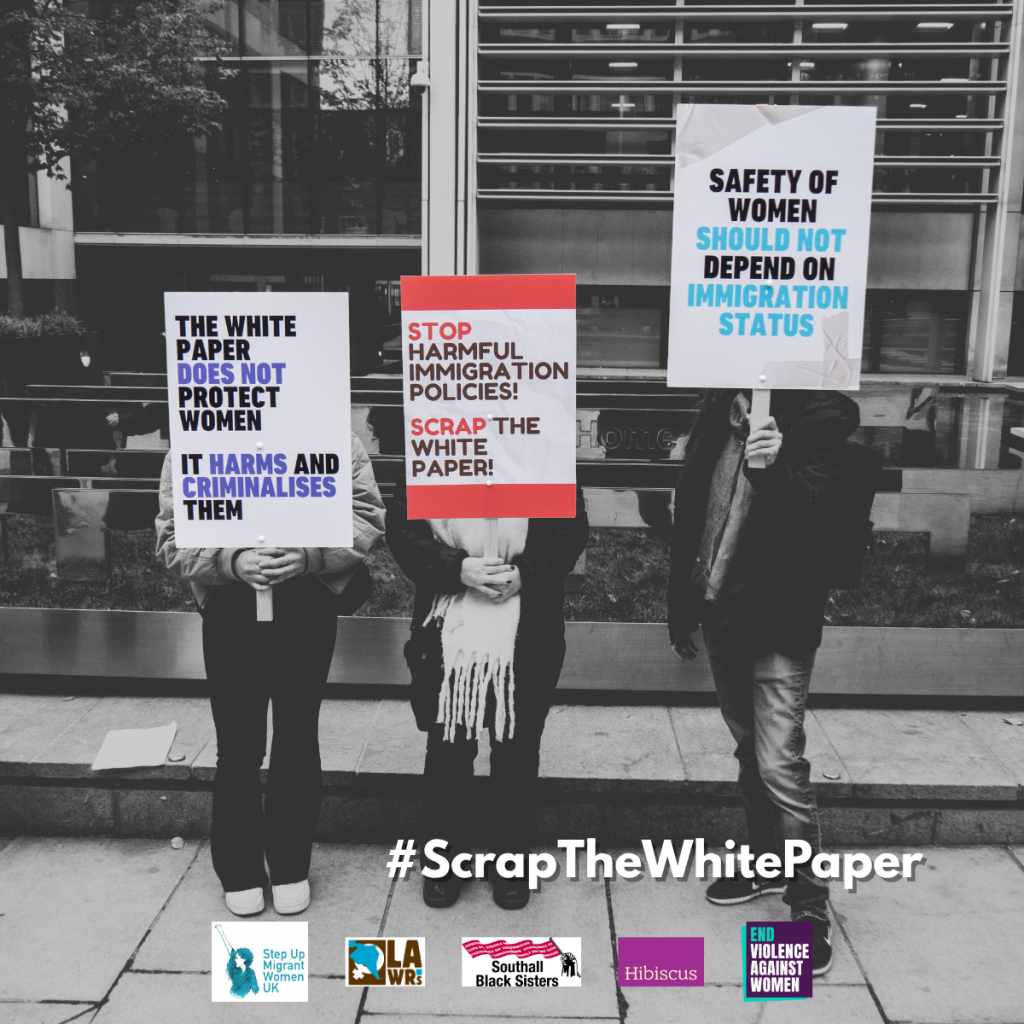
A LAWRS, junto com as organizações parceiras Southall Black Sisters, Hibiscus e EVAW, e apoiada por mais de 100 outras organizações, está lutando contra essas políticas cruéis. Lançamos uma resposta destacando como essas medidas prejudicarão as mulheres migrantes e encerramos com um protesto em frente ao Home Office no dia 15 de outubro. No entanto, sabemos que essa será uma luta longa — que
exigirá ação coletiva contínua, solidariedade entre movimentos e um compromisso constante em colocar no centro as vozes e a liderança das mulheres migrantes.
Por que estamos tão preocupadas?
A normalização da extrema-direita nas políticas de imigração
O Immigration White Paper representa uma escalada perigosa e racialmente discriminatória, que coloca a culpa da privação econômica e social nos imigrantes, e não na austeridade. O governo está normalizando a retórica da extrema-direita, utilizando-a para orientar a formulação de políticas reacionárias em um momento em que a violência contra imigrantes, solicitantes de asilo e refugiados está aumentando.
Isso é evidente não apenas no White Paper, mas também nas declarações subsequentes do Primeiro Ministro e de outros membros de seu gabinete, bem como na falta de ação do governo em condenar as atitudes de grupos de extrema-direita que têm como alvo migrantes e pessoas em busca de asilo.
Mulheres migrantes vítimas/sobreviventes de violência doméstica
O governo prometeu reduzir pela metade a violência de gênero em 10 anos. No entanto, em seu White Paper, falha em abordar a vulnerabilidade das mulheres migrantes sobreviventes de violência de gênero (VAWG, na sigla em inglês). Serviços de linha de frente, como a LAWRS, apoiam mulheres migrantes cuja incapacidade de acessar abrigos comuns, apoio financeiro, moradia estável ou orientação jurídica de qualidade as impede de fugir da violência doméstica e reconstruir suas vidas. As proteções existentes, como a Concessão para Vítimas Migrantes de Violência Doméstica (MVDAC) e a Autorização de Residência Permanente por Violência Doméstica (DVILR), são extremamente limitadas e abrangem apenas um número restrito de mulheres com status migratório precário.
Além disso, o risco de que serviços públicos — incluindo a polícia — compartilhem informações com as autoridades de imigração é diretamente utilizado como arma pelos agressores, desencorajando as denúncias e o acesso à proteção. Pessoas que agora ocupam cargos no governo já haviam ressaltado anteriormente a necessidade crítica de estabelecer uma barreira entre a fiscalização da imigração e a polícia. Apesar disso, os compromissos de remover esses obstáculos não foram cumpridos, e as proteções continuam inacessíveis para a maioria das mulheres migrantes vítimas/sobreviventes.
Mercado de trabalho e imigração
Este governo continua a desvalorizar os cargos que classifica como de “baixa qualificação”, ocupados majoritariamente por mulheres migrantes no Reino Unido. Isso inclui o trabalho de cuidados, limpeza e serviços de apoio, setores em que as trabalhadoras essenciais já enfrentam condições precárias e falta de proteção adequada. A decisão de eliminar os vistos para cuidadoras é particularmente alarmante e coloca em risco de colapso um setor já frágil.
Nos preocupa o fato de que o planejamento real da força de trabalho e o investimento setorial estejam sendo substituídos pela dependência no trabalho de mulheres migrantes como soluções temporárias para a escassez de mão de obra. Ao restringir o acesso dessas trabalhadoras à estabilidade e à residência de longo prazo, essas políticas as forçam a aceitar condições precárias e aprofundam a dependência de parceiros ou empregadores — aumentando o risco de abuso e exploração.
Também rejeitamos completamente a narrativa do governo de apresentar o controle da imigração como uma forma de combater a exploração laboral. Essa abordagem distorce as verdadeiras causas do abuso no mercado de trabalho e pune as vítimas/sobreviventes, em vez dos empregadores exploradores que continuam a lucrar com sua vulnerabilidade.
Criminalização das vítimas/sobreviventes
No Reino Unido, a maioria das mulheres presas ou sob supervisão comunitária já sofreu algum tipo de abuso ou exploração. Para sobreviventes migrantes em situação de vulnerabilidade, a criminalização muitas vezes decorre de coerção ou de precariedade econômica. Como mencionado anteriormente, mulheres migrantes também enfrentam barreiras para denunciar abuso e exploração, o que faz com que fiquem invisíveis até entrarem em contato com o sistema de justiça criminal. A deportação automática e as remoções aceleradas impedirão que essas sobreviventes busquem justiça de forma significativa e reconstruam suas vidas.
Prioridades urgentes para ação
O governo enfrenta uma escolha urgente: continuar fortalecendo a ideologia de extrema-direita ou tomar
medidas imediatas para proteger vítimas/sobreviventes migrantes. Fazemos um apelo ao governo para
que:
- Abandone o Immigration White Paper do Governo do Reino Unido (maio de 2025), que prejudica vítimas/sobreviventes de violência contra mulheres e meninas (VAWG), tráfico e escravidão moderna.
- Implemente mecanismos seguros de denúncia.
- Acabe com a criminalização de vítimas/sobreviventes de VAWG, tráfico e escravidão moderna.
- Revogue integralmente a Lei de Migração Ilegal (2023) e a Lei de Nacionalidade e Fronteiras (2022).
- Combata o racismo sistêmico e as desigualdades estruturais.
- Centralize e garanta financiamento protegido para organizações conduzidas por e para mulheres migrantes.
- Estenda o modelo combinado MVDAC-DVILR a todas as vítimas/sobreviventes, independentemente de seu status migratório.
The Unheard Workforce
The Latin American Women’s Rights Service (LAWRS) is launching its latest report: “The Unheard Workforce: Experiences of Latin American migrant women in cleaning, hospitality and domestic work”
On the 17th July 2019, LAWRS launched the research “The Unheard Workforce: Experiences of Latin American migrant women in cleaning, hospitality and domestic work”. Funded by Trust for London
The research draws on 326 cases of women supported at the Employment Rights Advice Service of the organisation. It presents an array of deeply concerning labour rights violations experienced by Latin American migrant women employed in three key feminised sectors of London’s manual labour: cleaning, hospitality, and domestic work.
Among the key results arising from these cases, we found that:
- Over half of the workers faced breaches to their contracts (62%). Unlawful deduction of wages was the most common type of abuse (151 cases, 46%).
- 1 in 5 (20%) experienced illegal underpayment of the National Minimum Wage.
- 17% were unlawfully denied the annual leave they were entitled to, and 16% were not paid accrued in lieu annual leave once they left the company.
- Health and safety issues were present in 25% of the cases – predominantly injury due to the nature of the work (33%), limited or no protective equipment (17%), and lack of training (12%).
- Over two in five (41%) of women in the sample have experienced discrimination, harassment or unreasonable treatment.
- 66% experienced bullying or unreasonable treatment as regular occurrences.
- A large proportion endured verbal and/or faced physical abuse, 37% and 11% respectively.
- 16% of the women endured a total of 13 different types of sexual harassment and abuse in the workplace.
- Abuse on the grounds of maternity was experienced by 9% of women. This includes failure to pay for hours spent at prenatal appointments and denial of risk assessments during pregnancy.
- 11 cases of potential trafficking for labour exploitation were identified: 7 were cleaners or hospitality workers and 4 were domestic workers.
“We are not machines or numbers. We are human beings who want to work and to be treated with dignity and respect. We want nothing more and nothing less.”
Watch the full short documentary below:
“Undocumented Latin American migrant woman’s experiences of labour abuse in London”
This documentary was made with the support of Media Trust by the filmmaker Andrew Contreras


LAWRS 35th Anniversary report is out!
35 year ago, we started our work in a time where domestic violence was only physical abuse and we increased our services accordingly to the development of policies and legislation through the years. We are proud to follow the steps of amazing Latin American women who came before us and we hope to do our part for the ones to come. As a specialist service, we will continue providing survival, security, safety, and well-being and also advocating and campaigning for human rights and social justice for migrant women and migrant women workers in the UK.
During the last year 2017-2018, our main achievements were:
- 1,890 hours of comprehensive wellbeing support offered
- 1,691 advice and information sessions
- 339 survivors of violence supported to find safety
- 285 school students better able to lead healthy relationships
- 266 women joined in our integration programme
- 515 women supported in Southwark
- 124 women supported in Haringey
- 93% improved their knowledge about rights
- 85% improved their wellbeing
- 40% of our drop-in service users accessed more than 1 service in a single visit
- 70% found LAWRS through word of mouth
- Evidenced-based campaigning work to tackle violence against women and girls, labour exploitation and reduce the impact of Brexit
Read more here: LAWRS 35th Anniversary Annual Report

Voices of Resilience: short documentary
Migrant and refugee women face multiple barriers when arriving in the EU and the current political anti-migrant climate has made their situations direr. Experiences of gender-based abuse, exploitation at work and isolation have been exacerbated by the progressive erosion of migrant and women’s rights.
On International Migrant Day 2018, LAWRS launches the short documentary titled: “Voices of resilience: Migrant and Refugee women in Europe” which highlights the experiences of migrant women in the UK, Spain, Poland and Italy and sharing their experiences and calls for change.
The short documentary was made as part of the Women, Empowerment, Integration and Participation project (WEIP) run by LAWRS (UK), Differenza Donna (Italy), KARAT Coalition (Poland) and Red Acoge (Spain) and brought the voices and experiences of migrant and refugee women to the forefront. The documentary was first screened in November at the WEIP’s international conference in London, where more than 20 migrant and women organisations in Europe highlighted the role of migrant women’s lived experiences and provided recommendations to uphold their right to integrate and to live free of violence and discrimination.
Sophia Gomez Pelaez, a migrant woman in Spain, interviewed in the short documentary states:
“We come looking for other opportunities, especially as women as we are searching to cover family needs. However, it is difficult to find shelter as we often face rejection”
Moreover, Cathrine Nsamba, a migrant woman in Italy also interviewed (and photographed above) recommends:
“I was supported by the organisation to learn more and to understand more […]and my advice for women like me are to go inside leadership and campaign for these leaderships”
Finally, Alma Gatica, the WEIP Coordinator at the Latin American Women’s Rights Service stresses the importance of a migrant and gender perspective in our work.
“We, migrant women, have to get access to decision-making spaces where policies are discussed so we can fully participate in the host country: socially, politically and economically. We are the leaders of our own empowerment journey, both as migrants and as women”
Watch the full short documentary:
Co-funded by the Asylum, Migration and Integration fund of the European Commission

We can’t fight in the dark: Brazilian women facing violence
A research by the King’s College in partnership with LAWRS found out that VAWG among Brazilian women in London is “alarmingly widespread”, with 4 in every 5 Brazilian women in London have experienced some kind of violence.
The study, published in March 2018, shed a light on cases of violence suffered by Brazilian women in London, provided data and offered policy recommendations to tackle the issue. According to the study emotional/psychological violence was the commonest type of violence experienced in London (48%), followed by physical violence (38%), with 14% experiencing sexual violence.
The study also found that cases of VAWG are intersectional as women of mixed race were more likely to experience violence (63%) than white women (44%). Insecure immigration status prevented women from coming forward and reporting the cases of violence to the police. Apart from highlighting the need for the Domestic Violence and Abuse (DVA) Bill to set standards for the protection of migrant victims’, some of the proposed solutions to prevent VAWG cases with Brazilian women are extending ‘recourse to public funds’ to domestic violence victims, specialist training for agency officers; and increased collaboration between support organisations and government authorities. The study reinforces the need for safe reporting mechanisms to be implemented as we campaign in Step Up Migrant Women.


Relaunch of Sin fronteras: Empowering young women from Latin America
We are thrilled to announce the return of Sin Fronteras! Launched in June 2015, Sin Fronteras (No Limits) focuses on empowering young Latin American women and girls. Sin Fronteras provides them with a safe space to develop their full potential and lead on actions for social change through the use of arts. During the first two and a half years of the project, LAWRS offered different workshops and activities to more than 100 Latin American young women and girls. Through art, dance and music the young women and girls were able to identify themselves as agents that can generate a social change in our communities.
“We want to set an example, leave a footprint and speak up for Latin American people and for people from all over the world whose voices are silenced or to whom language is a barrier,” said the manifest written by members of the group.
They advocated for the recognition of young migrant women’s rights by calling for a recognition of rights through photography exhibitions, by demonstrating against detention at Yarl’s Wood, and by joining the campaign Against Border for Children (ABC). Here is Sin Fronteras standing up for the the right to education free from racism and state surveillance.
LAWRS is thrilled to relaunch Sin Fronteras in November 2018. We will run a 3-month creative leadership programme with the support of the University of London, a 1-year programme to access free university lectures thanks to King’s College London, and a 3-year programme of arts, development and social change funded by Paul Hamlyn Foundation. Stay tuned to get more news about the awesome things this group of young leaders will be doing in the coming months.

Step Up Migrant Women: Mayor of London calls for safe reporting for migrant victims
Prompted by our Step Up Migrant Women UK coalition, the Mayor of London Sadiq Khan urged the Home Office to protect domestic abuse victims who are vulnerable due to hostile environment policies. Migrant women with undocumented status are denied access to support and remain trapped in abusive relationships.
LAWRS worked with the Mayor’s office in drafting his letter to the Home Secretary, with measures and guidelines to ensure victims have access to justice and support services.
The Mayor’s demands were backed by Victims Commissioner Claire Waxman, who has been hosting a series of roundtables on the issue, and MP Jess Phillips.
“Both the mayor and I are clear that all victims of abuse must have full confidence to report crime and their abusers to ensure justice is done, no matter what their status might be,” said Claire Waxman
The current lack of safe-reporting mechanisms creates a barrier for migrant women to flee violence and gives greater impunity to perpetrators. An Imkaan study has shown that 92% of women with insecure status have received threats of deportation from perpetrators.
LAWRS’ Director, Lucila Granada, commented:
“The hostile environment policies have led to this extremely dangerous situation where many victims of severe crimes are too afraid to go to the police. Their perpetrator is dangerous, but the police can be even more dangerous to them. Perpetrators are hiding behind these policies and using them to abuse their victims.”
Step Up Migrant Women is a campaign led by LAWRS and supported by over 30 women’s and migrants’ rights organisations. We campaign for the implementation of safe-reporting mechanisms and the end of data-sharing policies when victims approach the police.
Photo by Angeles Rodenas

Research: Minorities face Barriers to Islington Health
LAWRS Development and Outreach Coordinator Nahir de la Silva explains how LAWRS and the consortium Diverse Communities Health Voice found that Latin American women in Islington need better quality and gender-specific interpretation services to access healthcare.
Diverse Communities Health Voice, a consortium of ten Islington-based organisations*, has published its findings on research into how ethnic minorities are accessing the NHS: Community research 2016-2017 Black and minority ethnic groups accessing services in Islington.
As a consortium member, LAWRS interviewed 22 Latin American women* within our organisation, with research broken down into five different areas: pharmacies, wellbeing, accident & emergency, interpreting services, and referrals to specialist services.
We offer services including linguistically-specific counselling and yoga to help our community keep healthy.
Our interviews found that women experienced their first barrier when trying to make appointments. Reception staff did not provide appointments due to a lack of language understanding of our service users. We also heard of cases in which staff members would not offer interpreting services, despite the knowing that our users were not comfortable only using English.
This interview-based research has helped LAWRS identify different issues faced by our service users while trying to access the NHS. It is also helping us work with the community and local government to tackle these problems.
At LAWRS we wrote letters addressed to administrative staff from GP clinics asking for appointments and interpreters. We managed to get some much-needed appointments. LAWRS also provided information on services on offer in pharmacies, as well as free sports and wellbeing activities, dentist services, walk-in-centres, and complaint procedures.
Our research has also helped us conclude that language interpreting services need to be improved in Islington, as well as become more culturally and gender secure. We would also appreciate reception staff receiving appropriate Equality and Diversity training.
The final report makes the following recommendations
• To extend GP hours in order to make it possible for people working in different jobs to get appointments
• To promote information about the services available
• To translate this information into key languages to increase uptake
Read the full report here.[:es]
LAWRS Development and Outreach Coordinator Nahir de la Silva explains how the consortium Diverse Communities Health Voice also indicates that Latin American women in Islington need better quality and gender-specific interpretation services to access healthcare.
Diverse Communities Health Voice, a consortium of ten Islington-based organisations*, has published its findings on research into how ethnic minorities are accessing the NHS: Community research 2016-2017 Black and minority ethnic groups accessing services in Islington.
As a consortium member, LAWRS interviewed 22 Latin American women* within our organisation, with research broken down into five different areas: pharmacies, wellbeing, accident & emergency, interpreting services, and referrals to specialist services.
Our interviews found that women experienced their first barrier when trying to make appointments. Reception staff did not provide appointments due to a lack of language understanding of our service users. We also heard of cases in which staff members would not offer interpreting services, despite the knowing that our users were not comfortable only using English.
This interview-based research has helped LAWRS identify different issues faced by our service users while trying to access the NHS. It is also helping us work with the community and local government to tackle these problems.
At LAWRS we wrote letters addressed to administrative staff from GP clinics asking for appointments and interpreters. We managed to get some much-needed appointments. LAWRS also provided information on services on offer in pharmacies, as well as free sports and wellbeing activities, dentist services, walk-in-centres, and complaint procedures.
Our research has also helped us conclude that language interpreting services need to be improved in Islington, as well as become more culturally and gender secure. We would also appreciate reception staff receiving appropriate Equality and Diversity training.
The final report makes the following recommendations
• To extend GP hours in order to make it possible for people working in different jobs to get appointments
• To promote information about the services available
• To translate this information into key languages to increase uptake
Read the full report here.[:pt]LAWRS Development and Outreach Coordinator Nahir de la Silva explains how the consortium Diverse Communities Health Voice also indicates that Latin American women in Islington need better quality and gender-specific interpretation services to access healthcare.
Diverse Communities Health Voice, a consortium of ten Islington-based organisations*, has published its findings on research into how ethnic minorities are accessing the NHS: Community research 2016-2017 Black and minority ethnic groups accessing services in Islington.
As a consortium member, LAWRS interviewed 22 Latin American women* within our organisation, with research broken down into five different areas: pharmacies, wellbeing, accident & emergency, interpreting services, and referrals to specialist services.
Our interviews found that women experienced their first barrier when trying to make appointments. Reception staff did not provide appointments due to a lack of language understanding of our service users. We also heard of cases in which staff members would not offer interpreting services, despite the knowing that our users were not comfortable only using English.
This interview-based research has helped LAWRS identify different issues faced by our service users while trying to access the NHS. It is also helping us work with the community and local government to tackle these problems.
At LAWRS we wrote letters addressed to administrative staff from GP clinics asking for appointments and interpreters. We managed to get some much-needed appointments. LAWRS also provided information on services on offer in pharmacies, as well as free sports and wellbeing activities, dentist services, walk-in-centres, and complaint procedures.
Our research has also helped us conclude that language interpreting services need to be improved in Islington, as well as become more culturally and gender secure. We would also appreciate reception staff receiving appropriate Equality and Diversity training.
The final report makes the following recommendations
• To extend GP hours in order to make it possible for people working in different jobs to get appointments
• To promote information about the services available
• To translate this information into key languages to increase uptake
Read the full report here.
*Overall, 207 people were interviewed, across all participant organisations in the consortium. LAWRS has now been a consortium member for two years.
*The ten Islington-based organisations work to listen to and represent members of society that are not being heard by mainstream agencies.

Love Does Not kill, Violence Does
O amor não mata, a violência sim foi nossa campanha de zero tolerância à violência contra as mulheres e meninas e que teve como objetivo a conscientização sobre a violência que afeta as mulheres latino-americanas e outras mulheres migrantes no Reino Unido.
Essa campanha destaca a importância de reconhecer a comunidade latino-americana como uma minoría étnica para que as mulheres da nossa comunidade possam acessar serviços que respondam de maneira efetiva às suas necessidades específicas.
Nós pedimos ao governo central e às autoridades locais para que:
- Providenciem serviços adequados e específicos que atendam às necessidades das mulheres migrantes sobreviventes de violência e abuso.
- Reconheçam oficialmente os/as latino-americanos/as como minoria étnica.
- Garantam financiamento para organizações comunitárias especializadas que respondam às necessidades de mulheres migrantes e outras minorias sobreviventes de violência e abuso.
Essa campanha foi lançada com a projeção do nosso curta-metragem “Mulheres invisíveis”, com uma audiência de mais de 130 líderes e ativistas da comunidade latino-americana. “Mulheres invisíveis” é baseado nas experiências de 3 de nossas usuárias. Suas histórias refletem as situações de abuso, exploração e pobreza que muitas mulheres latino-americanas que vivem no Reino Unido enfrentam.
Produzido por Literally Films e Media Trust, você pode assistí-lo aqui:
A projeção foi seguida por uma mesa redonda com a participação de um Membro do Parlamento do Partido Trabalhista, Stella Creasy, integrantedo gabinete paralelo Prevenção de Crime e defensora da campanha One Billion Rising, Katharine Round, diretora da agência Literally Films e diretora do curta-metragem “Mulheres invisíveis”; e Carolina Gottardo, diretora do LAWRS naquela ocasião. O debate foi presidido pela Professora Maxine Molyneux, diretora do Instituto das Américas, University College London.
Nossos pôsteres contra a violência em espanhol e português, foram exibidos em organizações, lojas, igrejas e outros espaços comunitários. Continuamos com nosso trabalho para exigir o reconhecimento oficial e o financiamento adequado para os serviços de apoio, mas as mulheres latino-americanas precisam do seu apoio na luta por igualdade.